’90s Nostalgia: When Life Had Fewer Screens and More Windows

The days we lived—not scrolled: a journey through our homes, schools, towns and villages, and a question for the way we live today.
Before you read further, pause for a moment.
Close your eyes and go back—not to a particular date, but to a feeling.
It is a morning somewhere in India in the 1990s. Perhaps it is a small village waking to the sound of birds, a hand pump and a bicycle bell. Perhaps it is a town where the milkman has just arrived, the newspaper has landed at the door and a familiar song is playing on the radio. Perhaps it is a city colony where children in uniforms are running downstairs because the school bus will not wait.
The air feels less hurried. The day has fewer notifications. Nobody knows exactly where everyone is at every moment, yet somehow people remain connected.
If you grew up in the 1980s or ’90s, you may not remember every detail. But you will remember the feeling: life happened around us, not through a screen held in front of us.
Mornings that belonged to the whole neighborhood

In those days, mornings had their own music.
There was the scrape of a broom across a courtyard, the whistle of a pressure cooker, a radio news bulletin, the call of a vegetable seller and the ringing bell of a passing bicycle. In villages, people walked to fields while the mist still rested on the ground. In towns, shopkeepers lifted their shutters one by one and sprinkled water outside their shops before beginning the day. In cities, balconies came alive with drying clothes, schoolbags and hurried goodbyes.
Doors remained open for longer. Neighbor's did not always telephone before visiting; often, they simply appeared. Someone came to borrow sugar, return a steel container or share news that could not wait until evening.
There were boundaries, certainly, but there was also a sense that life extended beyond one family’s walls.
School was a world we could touch
Then came school.
New textbooks were covered with brown paper, their labels filled in with our best handwriting. Notebooks smelled new for only a few days before their corners bent and secrets appeared on the last pages. Pencil boxes held sharpeners, tiny erasers and sometimes a prized fountain pen that leaked at the worst possible moment.
There was chalk dust on the blackboard, the echo of the morning assembly and the nervous silence when a teacher opened the attendance register. There were maps rolled above cupboards, charts made from sketch pens and school projects held together by glue that never dried quickly enough.
The lunch bell changed everything.
Steel tiffin boxes opened to reveal parathas, poha, idlis, lemon rice, puris, pickle or whatever the kitchen had prepared that morning. Food travelled from one bench to another until no one remembered whose lunch was whose. Friendships were built through exchanged bites, shared water bottles and promises to save the best piece for someone.

School ended, but childhood did not become an organised schedule. Some children walked home in groups. Some crowded into cycle rickshaws or buses. Others took village paths past ponds, fields and grazing cattle. Along the way, they bought orange ice lollies, imli, peanuts or sweets with the few coins in their pockets.
No parent could track every step on a map. Trust, familiarity and the watchful eyes of an entire neighborhood filled the space where technology had not yet arrived.
Every lane was a playground
Afternoons belonged to whoever reached the street first.
A narrow lane became a cricket pitch. Bricks became wickets, a wall became a boundary and the owner of the bat often became the team captain. In another corner, children played stapoo, pithoo, marbles, kho-kho, kabaddi, hide-and-seek or badminton with a racket whose strings had already begun to loosen.

Village children climbed trees, raced along dusty paths, swam in ponds or canals and returned home with stories they knew they should probably not tell. In small towns, an empty plot could host a cricket match, a kite battle and an evening fair—all in the same month. In housing colonies, a shouted name from a balcony was the original notification: it meant dinner was ready and playtime was over.
There were arguments about whether someone was out, whose turn came next and who had broken the neighbor's window. But those arguments taught us to negotiate, forgive and begin another game five minutes later.
We did not call it “social development.” We simply called it playing outside.
Homes held more than people
A ’90s Indian home had its own collection of sounds and textures.
The ceiling fan clicked at one particular speed. The desert cooler gave the room the smell of wet khus. Pickle jars rested in the sunlight. A mosquito coil burned quietly in one corner. Steel tumblers made water feel colder, and every home seemed to have a plastic bag containing many smaller plastic bags.
Summer holidays meant cousins arriving with suitcases and rooms somehow making space for everyone. Mattresses covered the floor at night. Grandparents repeated stories, children whispered long after lights-out and nobody needed a separate bedroom to create a private world.
When the electricity disappeared, life did not stop. Families carried chairs outside, moved to the terrace or gathered around a candle. Hand fans appeared. Someone complained about the heat; someone else began a story. The same power cut that switched off the television often switched on a conversation.
Boredom existed, of course. But boredom had doors. It led to comic books, paper boats, antakshari, carrom, made-up games and long walks to the corner shop for something that cost one rupee.
Towns and villages moved at the speed of recognition
The kirana shopkeeper often knew what a family needed before the list was opened. Purchases could be written in a small account book and settled later. The tailor remembered measurements. The postman knew names, houses and sometimes the importance of the letter he carried.
Market day in a village or small town was more than shopping. It was where people exchanged news, met relatives and learned what had happened beyond their lane. Bus stands were crowded with metal trunks, cloth bags and emotional farewells. A journey involved waiting, asking strangers for directions and trusting that someone would help.
Community could also be intrusive, and small places were not always easy for everyone. Nostalgia should not turn the past into perfection. Still, there was comfort in being recognized—in knowing that one’s presence, and sometimes one’s absence, would be noticed.
The little things were never little
Memory rarely returns as one complete story. It returns in fragments: a smell, a sound, a taste or an object we had forgotten until this moment.
Summer began with the final school bell and the feeling that the holidays might last forever. Suitcases came down from the cupboard for a journey to a grandparent’s home. Cousins arrived, sleeping arrangements changed and every room became noisier. Mangoes cooled in buckets of water. Pickles rested in the sun. Glasses of nimbu pani, aam panna, buttermilk or Rasna appeared in the afternoon, depending on where in India one called home. Children lay under a fan reading comics, then ran outside the moment the heat softened.
The monsoon brought another world. The first rain released the smell of wet earth, paper boats sailed through roadside streams and school shoes refused to dry before morning. A sudden downpour could turn the journey home into an adventure. In winter, quilts came out of metal trunks, families sat in patches of sunlight and peanuts were passed from hand to hand. The details changed across India’s many climates, but seasons did more than alter the temperature—they rearranged the life of the house.
Sundays had their own rituals even before the television was switched on. Hair was oiled, nails were cut, uniforms were washed and shoes were polished for Monday. Torn book covers were replaced. A parent stitched a loose button while the smell of a special lunch travelled from the kitchen. The newspaper passed through several hands, relatives visited without watching the clock and the afternoon moved slowly enough for everyone to take a nap.
A one-rupee coin could hold an entire plan. It might buy an orange sweet, imli, peanuts, a small ice lolly or a turn at a neighborhood game. Children studied the glass jars at the corner shop as carefully as adults now compare products online. Comics such as Tinkle, Champak, Nandan and Chacha Chaudhary were bought, borrowed, exchanged and read until their pages loosened. Stamps, marbles, cricket cards, film-star pictures, matchbox labels and colorful erasers became private treasures. We had fewer things, perhaps, but we knew every item we owned.
Journeys were not empty time between two locations; they became stories of their own. At railway stations, someone searched for names on a printed reservation chart while another guarded the luggage. Suitcases were pushed beneath the berth and sometimes secured with a chain. Families unpacked puri-aloo, lemon rice, idlis, parathas or homemade snacks, and before long, food was being offered to strangers who had become temporary companions. Children fought for the window seat, counted passing stations and waved at people they would never meet. On the platform, relatives continued walking beside the train until they could walk no farther.
Bus journeys had their own memories: luggage tied above, the conductor’s familiar call, a window that would not open—or would not stay closed—and a film song playing somewhere near the driver. Reaching a destination required patience, but the road, the conversations and the people met along the way became part of arriving.
Things were also expected to remain with us. A radio went to the repair shop. A watch waited for a new strap. A torn shoe visited the cobbler, a school uniform was altered for a younger sibling and old textbooks arrived with another child’s notes still in the margins. Tailors, cycle mechanics and neighbourhood electricians gave objects another life. Things stayed in the family long enough to gather marks, stories and affection.
Festivals were prepared, not simply delivered. Homes were cleaned, decorations made, clothes taken to the tailor and sweets prepared over long conversations in the kitchen. The names of the dishes and customs changed from one region and faith to another, but the instinct to share crossed every doorway. Plates travelled to neighbours and returned carrying something different. Weddings occupied courtyards, rooftops and entire lanes. Relatives arrived days early because celebration was not something they came only to witness; it was work they came to help create.
These were not grand events. That is precisely why they matter. They remind us that happiness often grew from participation—from waiting, preparing, repairing, sharing and being needed.
When one television belonged to the whole neighborhood
Television was not simply an appliance. For many families, it was still a luxury.
Research based on national household surveys suggests that only about one in ten Indian households owned a television in the early 1990s. Yet Doordarshan’s network already reached nearly 70 per cent of India’s population by 1990. The signal had travelled much farther than the television set—and so one screen often became a window for an entire neighbourhood.
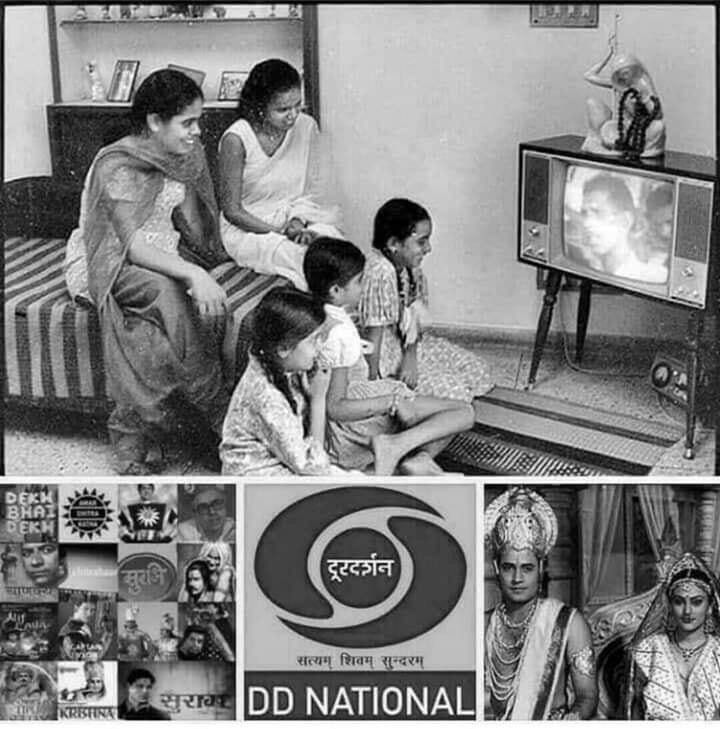
When a Sunday movie, popular serial or important cricket match was about to begin, neighbours started arriving. Children claimed places on the floor. A charpai, wooden stool or dining chair was pulled into the room for the elders. Someone sat near the television to adjust the volume, while another person climbed to the terrace to turn the antenna as voices shouted from below: “Stop—there! The picture is clear now!”
The family that owned the set did not merely switch it on; it hosted the evening. Tea moved around the room. Children were told to sit quietly and then failed within minutes. People laughed together, predicted what would happen next and continued discussing the story after the closing credits. Academic work on memories of Doordarshan describes this convivial experience of watching with families and neighbours, while accounts of programmes such as Ramayan record Sunday gatherings that often extended beyond a single household.
The television was at the centre of the room, but it was not the whole experience. The conversation around it mattered just as much.
Children finished their homework—or pretended to—before Shaktimaan began. Programmes such as Chitrahaar, Rangoli and Chandrakanta gave the week its small landmarks. A cricket match transformed drawing rooms, tea shops and village squares into shared stadiums. Sometimes a video cassette player was borrowed or rented, and several families gathered for the same film.
If you missed an episode, you could not stream it later. You waited for a friend to narrate it at school. If you loved a song, you waited for it to play on the radio and tried to record it on a

cassette without the announcer’s voice at the end.
Entertainment was limited, but anticipation made it larger—and sharing made it warmer.
Then, many families gathered around one screen. Today, one family can sit around many different screens.
We have gained unlimited choice, clearer pictures and the freedom to watch anything at any time. Somewhere along the way, however, we may have lost the pleasure of waiting, watching and talking together.
Memories were not created for an audience
A camera roll allowed only a limited number of photographs, so someone always asked, “Is this worth taking?” Then came the wait for the film to be developed.
When the envelope finally arrived, the family gathered around. Some photographs were beautiful. Others were blurred, badly lit or covered by a thumb. We kept them anyway.
Birthdays were remembered through greeting cards. A distant relative’s handwriting arrived inside an inland letter. Long conversations happened from an STD booth while someone watched the meter nervously. Photographs entered albums rather than feeds, and most happy moments were never shown to strangers.
We experienced them without wondering how they would look to others.
Technology has now removed almost every delay. We can take thousands of photographs, stream any song, find any route and reach someone across the world in seconds. These are extraordinary gifts.
But abundance has created a strange emptiness: when everything is captured, very little is revisited; when every moment can be shared, fewer moments feel entirely our own.
The past was not perfect—and progress is not the enemy
The India of the ’90s had real difficulties. Communication was slower and more expensive. Information and opportunities were not equally available. Many people lived within social limits that should not be romanticised. Technology has expanded education, created livelihoods, connected separated families, improved access to services and given millions a voice.
We do not need to go backwards.
And today’s children are not at fault for living in the world adults created for them. They cannot miss a childhood they were never offered.
The real question is not whether technology is good or bad. The question is whether we are using it to enrich life—or allowing it to replace life.
Are we doing this right?
We can speak to someone thousands of kilometres away, but do we listen to the person sitting beside us?
We have hundreds of contacts, but whom can we visit without an appointment?
We photograph every celebration, but are we fully present while it happens?
Our children are safer inside, but have we made outside so unfamiliar that they no longer know the freedom of a lane, a field or an unplanned afternoon?
We save time with technology, but where has the saved time gone?
Perhaps what we miss about the ’90s is not the landline, cassette, black-and-white television or handwritten letter. We miss what their limitations gave us: patience, attention, shared rituals, resourcefulness and the freedom to be unreachable.
Those things do not have to remain in the past.
We can bring one meal back to the dining table without phones. We can let children become bored enough to invent a game. We can print a photograph, visit a neighbor, call our grandparents, return to the terrace or spend an evening that produces no content for anyone else to see.
We do not need to recreate the 1990s exactly. We only need to carry forward what that decade understood: life is not measured by how quickly we can reach the whole world, but by how deeply we can be present in the small part of the world around us.
Before returning to your notifications, pause here for one more moment.
Remember your classroom. Your street. Your village path. Your favorite shop. The voice that called you home. The people who once filled your days and now live mostly in your memories.
Maybe nostalgia is not a wish to go backwards.
Maybe it is life asking whether, in our rush to move forward, we remembered to bring ourselves along.


Comments